









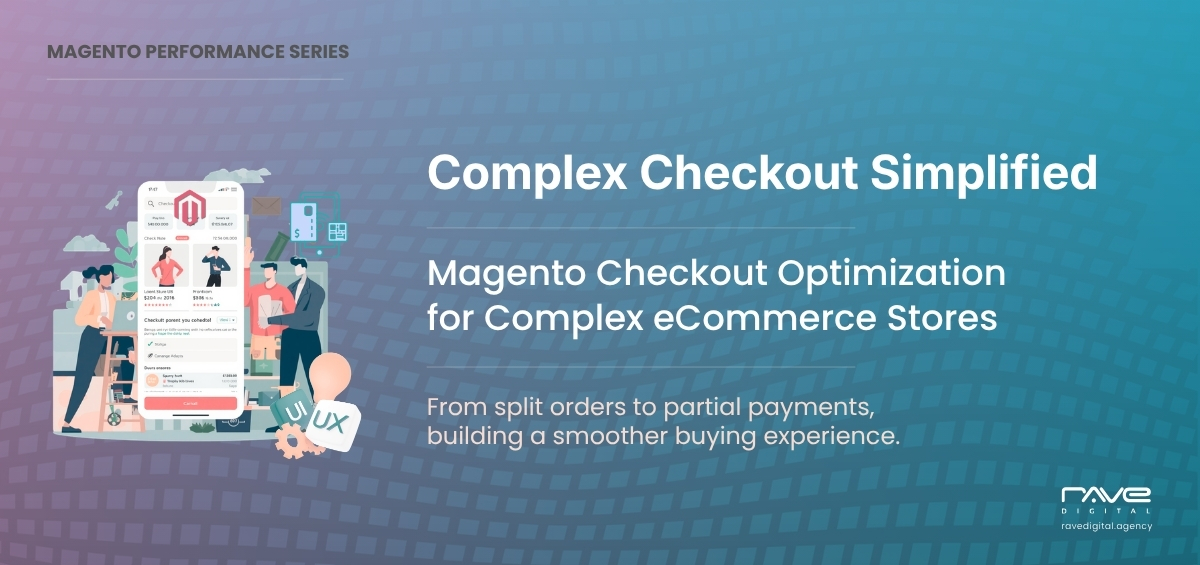
A Checkout Optimization Use Case for Growing Magento Stores
Checkout should feel simple for the customer, even when the business logic behind the order is complex.
For many Magento and Adobe Commerce merchants, checkout has to support more than a standard online purchase. A single order may involve different fulfillment rules, payment options, service items, delivery preferences, customer-specific logic, or backend order routing.
Over time, these requirements can turn checkout into a long, heavily customized process.
That was the challenge in this use case.
The store was operating with a complex multi-step checkout that had originally been built to support unique business workflows. But as the platform evolved, the checkout experience became harder for shoppers to complete and harder for the business to maintain.
The goal was not simply to redesign checkout.
The real objective was to simplify the buying journey while preserving the operational logic the business depended on.
Why Checkout Was Becoming a Growth Barrier
Checkout is one of the most important parts of any eCommerce store.
A shopper can browse products, add items to cart, review options, and show strong purchase intent. But if checkout feels too long, confusing, or rigid, the sale can still be lost at the final step.
In this case, the checkout experience created challenges for both customers and internal teams.
What This Meant for the Business
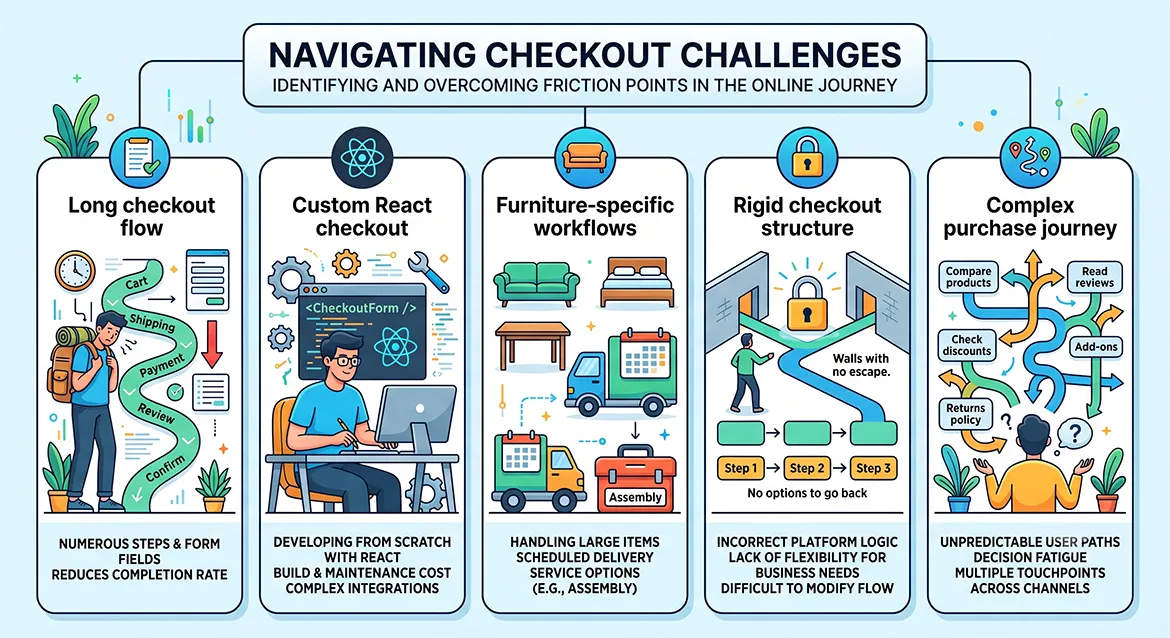
| Challenge | Business Impact |
|---|---|
| Long checkout flow | Customers had to complete more steps before placing an order |
| Over-customized checkout | Future improvements became harder to support |
| Complex order workflows | Checkout needed to manage different payment, shipping, and fulfillment rules |
| Rigid checkout structure | Updates required more effort and created higher maintenance risk |
| Friction in the purchase journey | Shoppers could experience hesitation before completing checkout |
For customers, the process felt longer than necessary.
For the business, the checkout became harder to maintain, improve, and align with standard Magento functionality.
The Core Problem: Checkout Was Too Customized for Long-Term Flexibility
The issue was not that Magento could not support the store’s checkout needs.
The issue was that the checkout experience had become too custom, too layered, and too dependent on a non-standard flow.
This created two major problems.
First, the buying journey included more steps than shoppers needed. Every extra step created more room for hesitation, confusion, or cart abandonment.
Second, the custom checkout structure made future payment and checkout enhancements more difficult. When checkout moves too far away from standard Magento patterns, every new payment requirement, fulfillment rule, or user experience improvement can require more compatibility planning.
The right path was to simplify the customer experience without removing the business rules that kept order processing accurate.
The Checkout Optimization Approach
1. Moving From a Long Checkout Flow to a Simpler Magento Checkout Experience
The first major improvement was reducing the checkout journey from a long, multi-step flow into a cleaner, more streamlined Magento checkout experience.
This helped create a more familiar and easier path to purchase.
Instead of asking shoppers to move through several disconnected stages, the new checkout experience brought the process into a more natural flow.
Merchant Impact
| Before Optimization | After Optimization |
|---|---|
| Checkout required too many steps | Checkout became shorter and easier to complete |
| Customers moved through a longer journey | The purchase flow became more intuitive |
| Checkout felt rigid and over-customized | The experience became easier to manage |
| Future updates were harder to plan | Checkout improvements became more flexible |
For shoppers, the benefit was simple: fewer steps and a smoother buying experience.
For the business, the benefit was a cleaner checkout foundation that could better support future improvements.
2. Preserving Complex Order and Payment Logic
A simplified checkout could not come at the cost of operational accuracy.
The store still needed to support important business workflows behind the scenes. That included order rules, fulfillment logic, split-order handling, payment conditions, service-related items, and backend order flow.
The checkout replacement had to protect those workflows while presenting a simpler experience to the shopper.
Important workflows preserved included:
- Mixed cart handling
- Split-order routing
- Delivery and fulfillment logic
- Partial payment support
- Service-related cart item handling
- Order flow into backend systems
This was important because many Magento stores have business-specific workflows that standard checkout experiences must still support.
A cleaner checkout is valuable only if the business can continue processing orders accurately.
3. Creating a Better Foundation for Payment Gateway Flexibility
The older checkout structure also created limitations around payment gateway flexibility.
Because the checkout was highly customized, adding or evaluating modern payment options required more effort. Standard payment providers generally work better when checkout follows Magento’s expected structure and flow.
By moving closer to a standard Magento checkout foundation, the store gained more flexibility for future payment planning.
This does not mean every payment requirement becomes simple. Stores with unique payment, shipping, or order handling rules still need careful evaluation.
But simplifying the checkout foundation reduces unnecessary custom complexity and makes future improvements easier to manage.
Why This Matters for Merchants
| Checkout Requirement | Why It Matters |
|---|---|
| Partial payments | Supports business-specific payment scenarios |
| Split-order logic | Allows different product types to follow separate fulfillment rules |
| Multi-shipping needs | Helps handle orders with different delivery paths |
| Payment processor compatibility | Supports future payment flexibility |
| Cleaner checkout architecture | Reduces maintenance and integration friction |
Checkout optimization is not only about reducing clicks.
It is about making checkout easier for customers and easier for the business to support over time.
4. Improving Customer Experience Without Disrupting Operations
The biggest risk in checkout replacement is disrupting existing business processes.
For this Magento store, checkout needed to become easier for customers without breaking the workflows used by internal teams and backend systems.
The optimization focused on customer-first simplification while maintaining operational continuity.
That balance helped improve the front-end buying journey while keeping essential backend processes intact.
Before vs. After
| Before Checkout Replacement | After Checkout Replacement |
|---|---|
| Long checkout flow created more friction | Shorter Magento checkout simplified the journey |
| Customer path felt less intuitive | Buying flow became easier to understand |
| Custom structure complicated future planning | Checkout foundation became more flexible |
| Business rules were tied into a complex flow | Key operational logic was preserved |
| Checkout was harder to maintain | Future improvements became easier to manage |
This made checkout more usable without forcing the business to give up important operational requirements.
The Result: A Simpler Checkout With Business Logic Still Intact
The checkout optimization created a better experience for both customers and internal teams.
Customers could move through a shorter, more familiar checkout journey. The buying process became easier to understand, fewer steps were required, and the overall experience felt more aligned with modern eCommerce expectations.
At the same time, the store preserved the workflows needed to support accurate order handling.
Improvement Area and Business Outcome
| Improvement Area | Business Outcome |
|---|---|
| Checkout simplification | Customers can complete purchases with fewer steps |
| Magento checkout alignment | Store follows a more maintainable checkout foundation |
| Split-order support | Fulfillment workflows remain intact |
| Partial payment logic | Important payment scenarios are still supported |
| Gateway readiness | Future payment planning becomes more manageable |
| UX improvement | Shopping journey becomes easier and more customer-friendly |
Most importantly, the store no longer had to choose between customer experience and operational complexity.
It could support both.
What Merchants Can Learn From This Use Case
Complex checkout requirements are common in Magento stores.
A customer journey may involve delivery coordination, payment rules, product availability, service add-ons, account-specific conditions, or multiple fulfillment scenarios.
That complexity should be handled behind the scenes, not pushed onto the shopper.
The key takeaway from this use case is simple:
A strong checkout experience should make complex operations feel simple to the customer.
For Magento and Adobe Commerce merchants, checkout optimization should focus on:
- Reducing unnecessary checkout steps
- Preserving business-critical workflows
- Improving payment gateway flexibility
- Supporting fulfillment complexity
- Creating a cleaner long-term checkout foundation
- Making the buying journey easier for shoppers
A better checkout does not always mean removing complexity from the business.
It means organizing that complexity in a way that does not slow down the customer.
Is Checkout Friction Affecting Your Magento Store?
If your Magento store is experiencing:
- Long checkout flows
- Cart abandonment concerns
- Payment gateway integration challenges
- Split-order complexity
- Multi-shipping limitations
- Partial payment workflow issues
- Checkout usability problems
- Business-specific order logic conflicts
It may be time to review whether your checkout experience is helping customers complete purchases or making the journey harder than it needs to be.
At Rave Digital, we help Magento and Adobe Commerce merchants simplify checkout, improve user experience, preserve custom business workflows, and build more scalable commerce foundations.
Turn Checkout Into a Conversion Driver
Streamline the buying experience, reduce abandonment, and support complex business requirements without compromising usability.