









Architecture Decisions Shape Magento Growth
For Magento and Adobe Commerce merchants, architecture is not just a technical decision. It directly affects how fast your store loads, how reliably checkout works, how easily your team can launch campaigns, and how much revenue your platform can support as the business grows.
Many merchants only think about architecture when something breaks.
Pages slow down. Checkout becomes unstable. Product updates take too long. Integrations fail. Admin tasks become harder. Developers take longer to release changes. Campaign performance drops because the platform cannot keep up with demand.
But these problems usually do not appear overnight.
They are often the result of early architecture decisions that were made for speed, convenience, or short-term business needs without considering long-term scale.
Choosing the right Magento architecture means building a commerce foundation that can support growth, not restrict it.
Why Magento Architecture Matters for Merchants
Magento is powerful because it is flexible. It can support large catalogs, complex pricing, B2B workflows, multiple storefronts, third-party integrations, custom checkout rules, and advanced merchandising.
But that flexibility needs structure.
Without the right architecture, flexibility can turn into complexity. A store that was once easy to manage can become slow, fragile, and expensive to maintain.
For merchants, poor architecture can lead to:
- Slower page load times
- Higher cart abandonment
- Checkout errors during peak demand
- Delayed product and inventory updates
- Integration failures
- Higher development and maintenance costs
- Longer release cycles
- Reduced ability to scale campaigns
- Lower organic visibility due to performance and crawl issues
- Revenue loss during high-traffic periods
The right Magento architecture helps merchants protect performance, improve operational efficiency, and scale revenue with confidence.
The Merchant Shift: From Store Setup to Growth Architecture
Many merchants approach Magento architecture as a one-time setup decision.
They choose hosting, install extensions, connect integrations, customize workflows, and launch the store. But as the business grows, new requirements keep getting added.
More products. More traffic. More promotions. More customer segments. More shipping rules. More third-party tools. More reporting needs. More custom logic.
At some point, the store is no longer just a website. It becomes a connected commerce system.
That is why architecture should not be planned only around today’s requirements. It should be designed around future growth.
The question is not:
“Can Magento support this feature?”
The better question is:
“Can our Magento architecture support this feature at scale without slowing performance, increasing risk, or limiting revenue?”
10 Magento Architecture Factors Merchants Should Evaluate
Choosing the right Magento architecture requires looking beyond hosting or frontend design. Merchants need to understand how every layer of the commerce system affects performance, scalability, operations, and revenue.
| Architecture Factor | What Merchants Should Evaluate | Business Impact |
|---|---|---|
| 1. Hosting & Infrastructure Readiness | Review whether the hosting environment can support current traffic, future growth, large campaigns, and backend workloads. | A strong infrastructure foundation reduces downtime risk, improves speed, and supports growth during high-demand periods. |
| 2. Caching Strategy | Evaluate CDN, Varnish, Redis, full-page cache, browser caching, and cache warming processes. | Better caching reduces server load, improves page speed, and protects revenue during traffic spikes. |
| 3. Database Scalability | Review database load, slow queries, deadlocks, order processing pressure, indexing activity, and reporting workloads. | A scalable database keeps product pages, cart, checkout, and admin operations stable as the store grows. |
| 4. Frontend Architecture | Decide whether the store should use Luma, Hyvä, PWA, headless, or a custom frontend approach based on speed, flexibility, and maintenance needs. | The right frontend improves user experience, Core Web Vitals, conversion rate, and long-term development efficiency. |
| 5. Checkout Stability | Review payment, tax, shipping, cart rules, custom checkout logic, and third-party dependencies involved in order placement. | A stable checkout protects revenue by reducing failed orders, abandoned carts, and campaign losses. |
| 6. Integration Design | Evaluate how ERP, CRM, OMS, PIM, shipping, tax, payment, marketing, and analytics systems connect with Magento. | Well-planned integrations reduce failures, prevent data delays, and keep operations running smoothly. |
| 7. Catalog & Indexing Strategy | Review catalog size, product update frequency, indexing triggers, batch processing, layered navigation, and search configuration. | Optimized catalog architecture helps large stores update faster, search better, and avoid backend slowdowns. |
| 8. Extension & Customization Control | Audit custom modules, third-party extensions, overlapping features, and code quality. | Leaner customization reduces technical debt, improves performance, and lowers upgrade risk. |
| 9. Deployment & Release Process | Review staging workflows, testing, rollback plans, version control, code review, and release timing. | A mature release process helps merchants launch changes faster with fewer bugs and lower business risk. |
| 10. Monitoring & Recovery Planning | Set up monitoring for performance, logs, checkout errors, integrations, server health, failed jobs, and alerts. | Proactive monitoring helps teams detect problems early and protect the customer experience before revenue is affected. |
Magento Architecture Selection Checklist for Merchants
Before choosing or changing your Magento architecture, review the following areas:
| Area | Merchant Question |
|---|---|
| Growth Planning | Can this architecture support our next stage of traffic, orders, catalog growth, and campaigns? |
| Performance | Will the storefront stay fast under normal and peak traffic conditions? |
| Checkout | Is checkout protected from unnecessary third-party or backend dependency risks? |
| Catalog Scale | Can product updates, search, indexing, and inventory workflows scale efficiently? |
| Integrations | Are external systems connected in a way that prevents failures from affecting customers? |
| Frontend | Does the frontend support speed, SEO, UX, and future design flexibility? |
| Customizations | Are custom modules controlled, documented, and aligned with business value? |
| Operations | Can the team deploy changes safely and recover quickly if something goes wrong? |
| Monitoring | Are performance, errors, integrations, and backend jobs being tracked continuously? |
| Revenue Impact | Does the architecture help protect conversion rate, campaign performance, and long-term growth? |
The Right Magento Architecture Depends on Business Goals
There is no single Magento architecture that works for every merchant.
A small B2C store, a large B2B distributor, a multi-brand enterprise retailer, and a high-volume marketplace-style catalog may all need different architecture choices.
The right approach depends on:
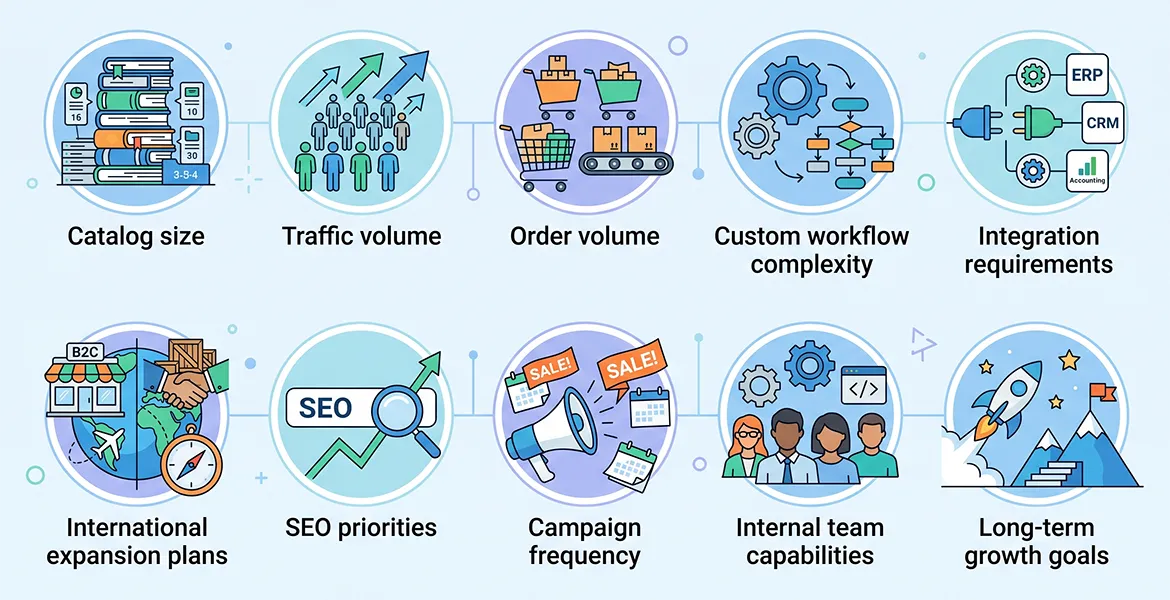
The best Magento architecture is the one that aligns technology decisions with business outcomes.
For some merchants, that may mean improving caching and database performance. For others, it may mean moving to Hyvä, simplifying extensions, restructuring integrations, or preparing for a more composable architecture.
Final Takeaway: Architecture Is a Growth Decision
Magento architecture is not just about how the store is built.
It is about how well the store can grow.
A strong Magento architecture helps merchants improve speed, protect checkout, reduce operational risk, support large catalogs, manage integrations, and convert traffic into revenue.
A weak architecture does the opposite. It creates performance issues, slows down teams, increases maintenance costs, and limits the store’s ability to scale.
For merchants, the most important question is not whether Magento can support growth.
Magento can.
The real question is whether your current architecture is ready to support the growth your business is planning for.