









The Missing Link Between Global Traffic and Global Revenue
Global traffic does not automatically turn into global revenue.
A Magento store may attract visitors from different countries, languages, and regions, but traffic alone does not mean those shoppers are ready to buy. If the shopping experience feels generic, unfamiliar, or disconnected from local expectations, visitors may leave before reaching checkout.
For Magento merchants expanding internationally, localization is no longer limited to translated product pages or local currency display. True localization means creating a buying experience that reflects how customers in each market search, compare, evaluate, and purchase.
It includes regional product discovery, localized content, market-specific trust signals, personalized merchandising, shipping clarity, and checkout confidence.
This is where AI can create a stronger advantage. With AI-driven localization, Magento merchants can move beyond basic translation and build shopping experiences that feel more relevant, searchable, and trustworthy in every market.
Global Traffic Is Not the Same as Local Trust
Many Magento merchants invest in international SEO, paid campaigns, multilingual content, and marketplace expansion to attract global visitors. These efforts may increase sessions, but they do not always improve conversions.
The reason is simple: global shoppers still need local confidence.
A customer in the United States, the United Kingdom, Germany, Canada, or the Middle East may use different product terms, prefer different payment methods, expect different delivery timelines, and evaluate trust in different ways.
A product page that performs well in one market may not work the same way in another.
For example, a U.S.-focused product description may not match how U.K. shoppers describe or search for the same item. A size guide may need local measurement formats. A shipping message may need to clarify duties, delivery timelines, or return eligibility. A promotion that feels clear in one country may feel incomplete in another.
When these details are missing, Magento stores may generate traffic without building enough confidence to convert.
Where Magento Localization Breaks Down
Many Magento stores translate content, but still miss what local buyers actually need. These common localization gaps can affect visibility, trust, product discovery, and regional conversion performance.
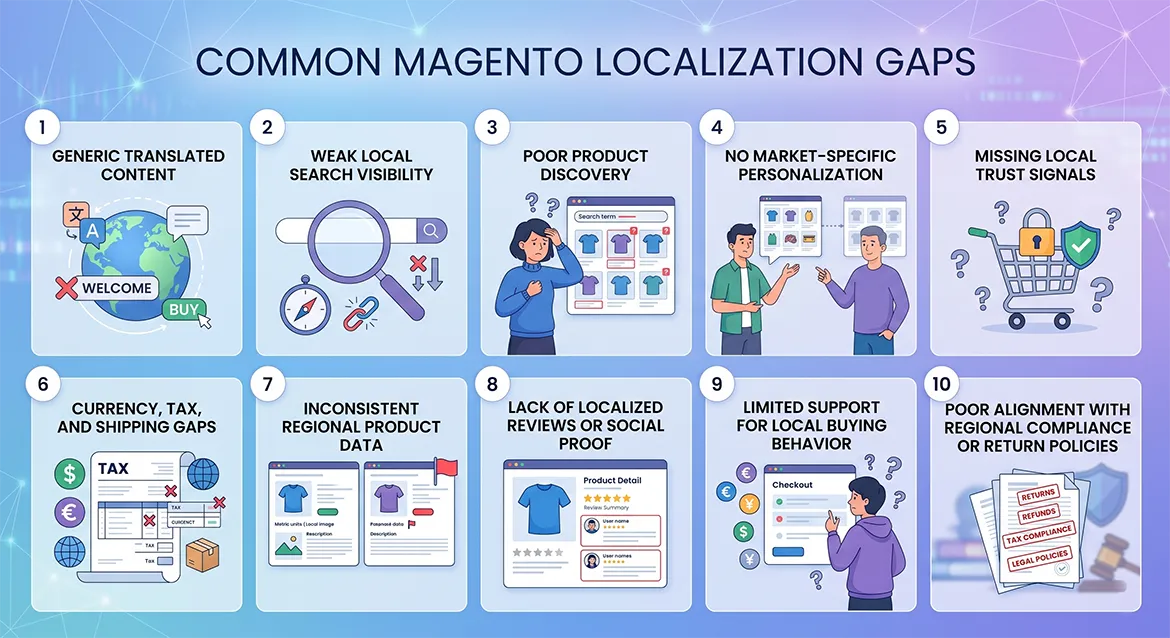
The more local the experience feels, the easier it becomes for shoppers to trust the store, find the right products, understand pricing and policies, and complete their purchase with confidence.
| Localization Gap | Why It Hurts Global Conversions | AI-Powered Strategy |
|---|---|---|
| Generic translated content | Direct translation may not reflect how customers search, compare, or buy in a specific region. | Use AI to adapt product descriptions, category copy, FAQs, and buying guides based on regional language, intent, and customer expectations. |
| Weak local search visibility | Broad global keywords may miss market-specific search demand and regional buying queries. | Use AI to identify local SEO keywords, conversational questions, AEO opportunities, and regional search patterns. |
| Poor product discovery | Shoppers may use local spellings, synonyms, slang, measurement terms, or buying-specific phrases. | Implement AI-powered search that understands local terminology, synonyms, natural language queries, and intent-based product discovery. |
| No market-specific personalization | Showing the same homepage, banners, recommendations, and offers to every shopper creates a generic experience. | Personalize banners, offers, recommendations, and product messaging based on location, behavior, seasonality, and market preferences. |
| Missing local trust signals | Global shoppers may hesitate if reviews, shipping details, payment options, or return information do not feel familiar. | Add localized reviews, shipping clarity, payment options, return messaging, support details, and market-specific FAQs. |
| Currency, tax, and shipping gaps | Unclear pricing, taxes, duties, or delivery timelines can create checkout hesitation and abandonment. | Use AI and data insights to identify pricing clarity gaps and improve market-specific shipping, duty, and tax messaging. |
| Inconsistent regional product data | Missing or mismatched product attributes, sizes, specs, or availability can reduce buyer confidence. | Standardize and enrich product data by region using AI-assisted attribute mapping, content validation, and product information checks. |
| Lack of localized reviews or social proof | Shoppers may not trust reviews or testimonials that do not reflect their region, language, or buying context. | Highlight region-relevant reviews, testimonials, ratings, and user-generated content to build local confidence. |
| Limited support for local buying behavior | Different markets may prefer different payment methods, promotions, support channels, or buying journeys. | Analyze regional behavior patterns and personalize checkout messaging, offers, payment visibility, and support options accordingly. |
| Poor alignment with regional compliance or return policies | Unclear compliance, privacy, warranty, or return information can create risk and hesitation for international buyers. | Use AI-assisted content reviews to identify policy gaps and create clearer region-specific compliance, return, and warranty messaging. |
How AI Helps Magento Stores Speak the Customer’s Buying Language
AI-powered localization is not just about changing words. It is about understanding buying behavior by market.
Different regions may use different search terms, compare products differently, and require different levels of reassurance before purchasing. AI can help Magento merchants identify these differences faster and apply them across content, search, merchandising, and checkout touchpoints.
AI can help Magento teams understand:
- Which product terms are commonly used in each region
- Which regional queries indicate purchase intent
- Which product attributes matter most to local shoppers
- Which questions should be answered before checkout
- Which trust signals are missing on key pages
- Which product and category pages need localized support
- Which content formats are easier for AI platforms to extract and summarize
This allows Magento merchants to create market-aware experiences instead of relying on one global storefront experience for every audience.
The Role of SEO, AEO, GEO, and LLMO in Magento Localization
Search behavior is changing. Customers are no longer relying only on traditional search engines. They are also using AI assistants, conversational search tools, voice search, and answer engines to compare products and make decisions.
That means Magento localization must support both traditional search visibility and AI-driven discovery.
- Localized SEO helps Magento stores rank for regional keywords, category searches, product terms, and commercial queries.
- AEO helps content answer market-specific questions clearly, such as shipping timelines, sizing, pricing, compatibility, returns, and product use cases.
- GEO helps AI search engines and generative platforms understand and reference brand, product, and category content accurately.
- LLMO improves how large language models interpret, summarize, and surface Magento content through structured, factual, and entity-rich information.
Together, these strategies help Magento merchants improve visibility across search engines, AI platforms, and answer-driven discovery experiences.
The Localization Layer Magento Merchants Should Build
To convert global shoppers, Magento merchants need a localization layer that connects content, search, personalization, product data, and trust.
This layer should include:
Region-Specific Product Content
Product pages should reflect local terminology, buying intent, sizing expectations, product use cases, and decision-making needs. AI can help adapt product copy for different markets while keeping the core product information accurate and consistent.
Localized Category Experiences
Category pages should be more than translated versions of the same content. They should reflect how local shoppers search, filter, compare, and decide. This may include localized headings, buyer guides, FAQs, internal links, and market-specific product sorting.
AI-Powered Product Search
Magento stores can improve discovery with AI search that understands synonyms, spelling variations, natural language queries, and regional terminology. This helps shoppers find relevant products even when they do not use the exact product title or attribute name.
Personalized Merchandising
AI can support location-aware banners, product recommendations, category promotions, and offers based on shopper behavior, seasonality, and regional preferences. This helps the storefront feel more relevant to each audience segment.
Local Trust and Checkout Signals
Trust-building content should be visible before checkout, not hidden in policy pages. Magento stores should clearly display region-specific shipping details, delivery timelines, payment options, return information, support details, and customer reviews where relevant.
Structured Content for AI Extraction
Magento content should be organized so both search engines and AI platforms can understand it. This includes schema markup, FAQs, product attributes, comparison tables, clear headings, short answer sections, and consistent entity references.
From Global Visitors to Local Buyers
International growth is not only about reaching more visitors from more countries. It is about making each shopper feel that the store understands their market, language, concerns, and buying expectations.
Magento gives merchants the flexibility to support global commerce, but AI helps make that experience smarter, faster, and more relevant.
With the right AI localization strategy, Magento merchants can improve:
The goal is not just to translate a Magento store.
The goal is to make every market feel intentionally served.
Creating Localized Magento Experiences
Global shoppers expect more than a translated website. They expect product content that makes sense, search results that understand their language, pricing and shipping details that feel clear, and trust signals that reduce hesitation.
AI localization helps Magento merchants close the gap between global visibility and local conversion.
By combining AI-powered content adaptation, regional SEO, conversational intent mapping, personalized merchandising, structured data, and market-specific trust signals, Magento stores can create stronger buying experiences for international customers.
For merchants expanding into new regions, the opportunity is clear: build a Magento experience that does not just reach global shoppers, but converts them.
Make Your Magento Store Feel Local in Every Market
Improve product discovery, AI visibility, and international conversion with smarter localization strategies.