









B2B Buyers Do Not Want More Steps
B2B buyers do not want more steps. They want faster ordering, accurate product selection, fewer back-and-forth conversations, and a buying experience that understands how they actually purchase.
Yet many B2B orders still happen through spreadsheets, emails, phone calls, PDFs, sales rep follow-ups, and manual reorder requests.
This creates friction for both buyers and internal teams.
Buyers spend time searching for the right products, confirming compatibility, checking order history, and waiting for responses. Sales and customer service teams spend time answering repeat questions, rebuilding orders, correcting product selections, and handling tasks that could be automated.
This is where AI-guided buying can change the experience.
Instead of forcing buyers to manually search, compare, and reorder, AI can help guide them toward the right products, quantities, configurations, and workflows based on purchase history, buyer intent, product relationships, and procurement patterns.
The future of B2B commerce is not just digital ordering.
It is assisted buying.
Why B2B Buyers Still Fall Back on Manual Ordering
Many B2B companies have ecommerce portals, but buyers still return to manual ordering methods.
The reason is simple: the digital experience often does not match the complexity of B2B buying.
A buyer may need to order by SKU, match products to equipment, follow contract pricing, stay within approval rules, reorder from past purchases, or confirm compatibility before placing an order. If the website makes these tasks harder, the buyer goes back to what feels safer: email, spreadsheets, phone calls, or sales rep support.
Manual ordering usually continues when:
- Product data is difficult to search
- Buyers are unsure which item fits their need
- Reorder workflows are not simple
- Account-specific pricing is unclear
- Product compatibility is not visible
- Approval or procurement steps are disconnected
- Buyers do not trust the digital experience
A B2B portal may be online, but if it does not reduce effort, buyers will not fully adopt it.
That is why B2B buying experience improvements must focus on guidance, accuracy, and convenience, not just catalog access.
Where Manual B2B Buying Creates Friction
B2B ordering is often more complex than standard ecommerce. Buyers may not be browsing casually. They are usually trying to solve a specific business need quickly and correctly.
| Manual Buying Problem | Why It Slows B2B Commerce | AI-Guided Solution |
|---|---|---|
| Buyers rely on spreadsheets | Repetitive orders take longer and increase the risk of outdated SKUs, wrong quantities, or manual entry errors. | AI can suggest products from purchase history, saved lists, account behavior, and recurring order patterns. |
| Product selection is complex | Buyers may struggle to identify compatible products, replacement parts, accessories, or approved alternatives. | Guided search can recommend compatible items, related products, and fit-based options using product data and buyer intent. |
| Reorders take too long | Buyers must manually search past orders, rebuild carts, or contact sales for repeat purchases. | Predictive reorder prompts can surface likely items, quantities, and reorder timing based on historical buying behavior. |
| Sales teams handle repetitive requests | Sales reps spend time answering common product, pricing, availability, and reorder questions. | AI can assist with common ordering workflows, FAQs, product suggestions, and self-service account support. |
| Buyers abandon digital ordering | If the portal feels difficult or unreliable, buyers return to email, calls, or offline processes. | Personalized buying paths can improve self-service by showing relevant products, pricing, and order options faster. |
The Shift From Product Search to Guided Buying
Traditional B2B ecommerce often starts with search.
The buyer types a product name, SKU, category, or keyword and hopes the right result appears.
But many B2B buyers do not always know the exact product name. They may know the problem, equipment type, reorder need, project requirement, or previous item they purchased. They may also need compatible accessories, replacement parts, approved substitutes, or bulk order options.
This is where guided product search becomes valuable.
AI can help interpret buyer intent and connect search behavior with product data, account history, purchase patterns, and compatibility rules. Instead of only showing a list of results, AI can guide the buyer toward the most relevant next step.
For example, a buyer may search for a replacement product. AI can recommend the current version, compatible alternatives, related accessories, and previously purchased items from the same account.
This turns search from a basic lookup tool into a guided buying experience.
How AI Understands Buyer Intent in B2B Commerce
AI in B2B commerce works best when it is connected to meaningful data.
That data may include order history, account type, contract pricing, product attributes, search terms, cart behavior, quote history, approval workflows, and product relationships.
With the right data foundation, AI can help understand what the buyer is trying to do.
A buyer searching for a product may be looking to reorder, replace, compare, configure, or complete a larger order. AI can use behavioral signals to support the correct path.
For example:
- A repeat buyer may need a faster reorder flow
- A technical buyer may need compatibility guidance
- A procurement manager may need approved items and account pricing
- A new buyer may need product education and recommendations
- A bulk buyer may need quantity-based suggestions
- A service team may need parts tied to equipment or previous purchases
This level of guidance helps reduce confusion and supports more confident ordering.
The goal is not to make AI guess randomly.
The goal is to use data to make the buying journey more relevant and efficient.
Making Complex Procurement Feel Simple
B2B buying often includes more steps than B2C ecommerce.
There may be purchase approvals, budget controls, contract pricing, negotiated terms, shipping rules, custom catalogs, recurring orders, product restrictions, quote requests, and account-specific workflows.
If these steps are not connected inside the digital experience, buyers will continue using manual processes.
B2B procurement automation helps simplify this journey by turning repeat tasks into guided workflows.
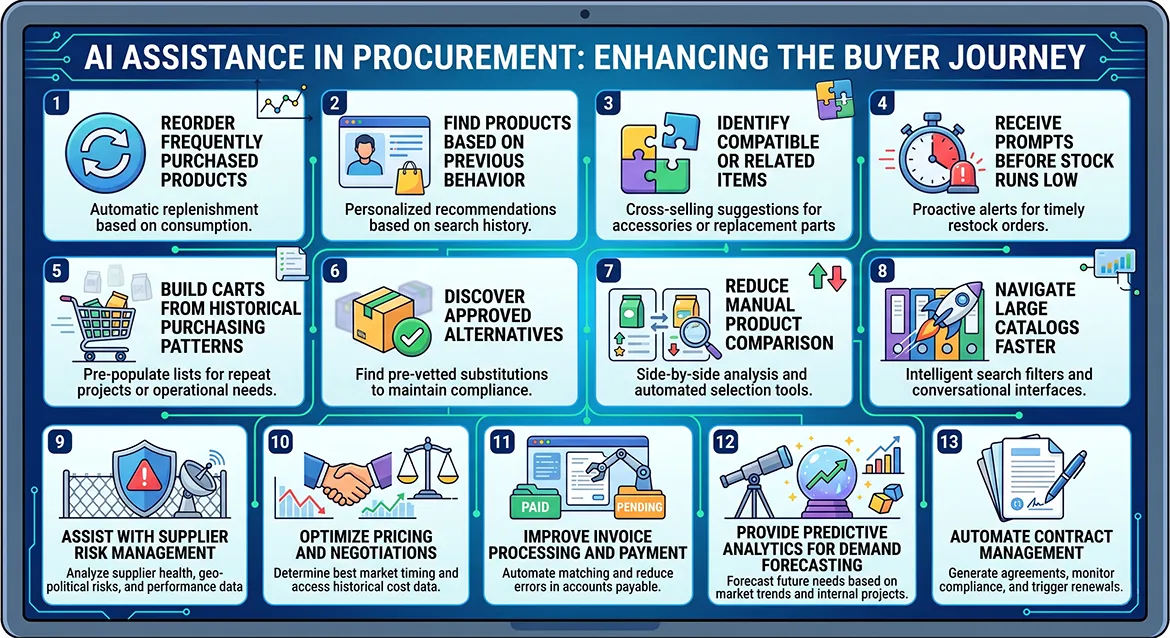
This makes procurement feel less like a manual task and more like a supported buying journey.
For merchants, it also reduces pressure on sales and support teams by moving more routine ordering activity into self-service channels.
Predictive Reordering Can Reduce Buyer Effort
Reorders are one of the biggest opportunities for B2B order automation.
Many B2B buyers purchase the same products repeatedly, but the reorder process is often more manual than it should be. Buyers may search through past invoices, copy items from spreadsheets, email sales reps, or rebuild carts from scratch.
AI can make reordering easier by recognizing purchase cycles and suggesting likely products before the buyer starts from zero.
For example, AI can identify:
- Products ordered monthly or quarterly
- Items commonly purchased together
- Typical order quantities
- Seasonal reorder patterns
- Account-specific product preferences
- Products that may need replenishment
- Items missing from a repeat order
These prompts help buyers complete orders faster while reducing the chance of missing important products.
Predictive reordering is not just about convenience.
It can improve retention, increase self-service adoption, and help merchants capture repeat revenue more efficiently.
AI Can Support Sales Teams, Not Replace Them
AI-guided buying does not remove the value of sales teams.
It helps sales teams focus on higher-value work.
In many B2B organizations, sales reps spend too much time handling repetitive requests such as product lookups, reorder assistance, quote follow-ups, availability questions, and basic order support.
AI can assist with these common workflows so sales teams can spend more time on account strategy, complex deals, relationship building, product education, and growth opportunities.
This is especially important for B2B companies with large catalogs or frequent repeat orders.
When AI handles routine guidance, sales teams can focus on consultative selling.
That creates a better experience for both customers and internal teams.
Personalization Is Critical for B2B Self-Service
A generic ecommerce experience does not work well for B2B buyers.
Different accounts may have different pricing, product eligibility, order history, buying roles, approval rules, and preferred categories. If every buyer sees the same experience, the portal may feel less useful than contacting a sales rep.
B2B personalization helps make self-service more practical.
AI can personalize the buying path based on account behavior, order frequency, product interest, industry, location, and previous purchases.
This may include:
- Account-specific product recommendations
- Reorder shortcuts
- Recently purchased items
- Approved product lists
- Personalized search results
- Relevant accessories or replacement parts
- Contract-aware product visibility
- Buying journey prompts
When buyers see what is relevant to them faster, they are more likely to use the digital channel.
This improves portal adoption and reduces manual dependency.
The Future of B2B Ordering Is Assisted, Not Manual
The future of B2B ecommerce is not simply moving offline orders online.
It is creating smarter buying experiences that understand the buyer’s role, account history, product needs, and procurement behavior.
AI-guided buying can help B2B merchants shift from reactive order support to proactive buying assistance.
Instead of waiting for buyers to search, struggle, or contact sales, AI can guide them toward the right products and next steps.
This creates a commerce experience that is faster, more accurate, and easier to repeat.
The strongest B2B platforms will not only display products.
They will help buyers make better purchasing decisions.
Building an AI-Guided Buying Roadmap
AI-guided buying works best when it is built on a strong foundation.
Before adding advanced AI features, B2B merchants should review their product data, account workflows, search experience, integrations, and ordering logic.
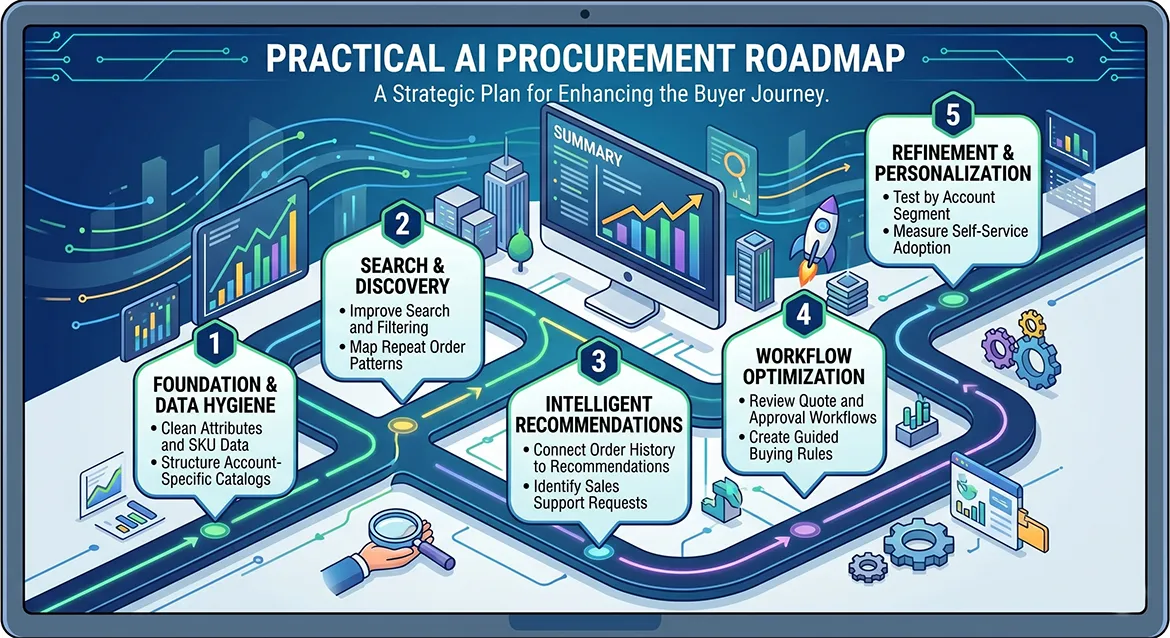
The goal is not to add AI for the sake of automation.
The goal is to remove friction from the buying journey.
AI-Guided Buying Turns Complexity Into Confidence
B2B commerce will always involve complexity.
The opportunity is to make that complexity easier for buyers to navigate.
When AI understands order history, product relationships, buyer intent, and procurement behavior, it can help create smoother buying paths and reduce manual effort.
For merchants, this means fewer repetitive requests, stronger self-service adoption, better product discovery, and more efficient ordering workflows.
For buyers, it means faster decisions, fewer mistakes, and more confidence in every order.
That is the real value of AI-guided buying.
It does not just automate the transaction.
It improves the buying experience.
Improve B2B Buying With Smarter AI Guidance
Ready to improve B2B buying experiences?
Explore AI-guided ordering, smarter search, and workflow automation for your commerce platform.