









The Hidden Manual Work Slowing Down eCommerce Teams
eCommerce teams are expected to do more with fewer resources.
More products. More campaigns. More customer requests. More reporting. More channels. More inventory movement. More operational complexity.
Growth creates opportunity, but it also creates pressure. As stores scale, internal teams often spend too much time on repetitive work that keeps the business running but slows down strategic progress.
Product teams clean data manually. Support teams answer the same questions repeatedly. Marketing teams build segments from scattered reports. Merchandising teams react to stock movement after issues appear. Operations teams track inventory updates across different systems.
This is where AI eCommerce efficiency becomes a real advantage.
AI can help teams reduce manual effort, identify patterns faster, automate repetitive decisions, and turn operational data into useful actions. The goal is not to replace human teams. The goal is to help them work smarter, faster, and with more focus.
Smarter commerce starts behind the scenes.
Why Manual Workflows Become a Growth Barrier
Manual workflows may work when a store is smaller.
But as product catalogs grow, order volume increases, customer expectations rise, and campaigns become more complex, manual work becomes harder to manage.
The problem is not only time.
Manual workflows can also create errors, delays, inconsistent data, missed insights, and slower decision-making. A product may be categorized incorrectly. A support question may take too long to answer.
A campaign segment may be built too late. A stock issue may be noticed only after sales are affected.
Over time, these small inefficiencies can limit growth.
This is why eCommerce workflow automation matters. It helps teams reduce repetitive work so they can focus on higher-value tasks such as strategy, customer experience, merchandising decisions, and revenue growth.
AI creates value when it removes friction from the work teams already do every day.
Where AI Creates Immediate Operational Relief
AI can support many areas of eCommerce operations, but the biggest impact often starts with repetitive workflows that consume time, create bottlenecks, or depend on manual review.
| Manual Workflow | Why It Slows Teams Down | AI Efficiency Strategy |
|---|---|---|
| Product data cleanup | Teams spend hours fixing missing attributes, inconsistent categories, duplicate descriptions, and incomplete product details. | Use AI product data enrichment to improve categorization, attribute mapping, descriptions, and data consistency. |
| Customer support questions | Support teams repeatedly answer common questions about shipping, returns, products, order status, and availability. | Use AI assistants to handle common queries, recommend responses, and escalate complex issues to human agents. |
| Campaign segmentation | Marketing teams often build audience groups manually from order history, engagement, or customer behavior. | Use predictive customer grouping to create smarter segments based on purchase behavior, intent, lifecycle stage, and engagement. |
| Reporting overload | Teams spend too much time pulling reports instead of acting on insights. | Use automated insights and anomaly detection to surface performance changes, revenue shifts, and operational risks faster. |
| Inventory alerts | Stock issues may be identified too late when teams rely on manual checks or delayed reports. | Use predictive stock and demand monitoring to flag potential stockouts, overstock, and demand shifts earlier. |
Product Data Automation Improves Store Quality
Product data touches almost every part of an eCommerce store.
It affects search, filters, product pages, recommendations, SEO, feeds, merchandising, and customer confidence. When product data is incomplete or inconsistent, customers may struggle to find the right item, compare products, or trust the information on the page.
Manual cleanup can become overwhelming, especially for stores with large catalogs or frequent product updates.
AI can help improve eCommerce operational efficiency by assisting with product enrichment, categorization, attribute mapping, duplicate detection, and content consistency.
For example, AI can help identify products missing key attributes, suggest better category placement, create draft descriptions, flag inconsistent naming, and support feed-readiness checks.
Human review is still important, but AI can reduce the time needed to find and fix data gaps.
Cleaner product data helps the store work better across search, merchandising, SEO, and conversion.
AI Customer Support Reduces Repetitive Work
Customer support teams often handle the same questions every day.
Where is my order? What is the return policy? Is this product compatible? When will it be back in stock? What shipping options are available? Can I change my order?
These questions matter, but they can take time away from more complex customer issues.
AI customer support can help answer common queries, suggest responses, organize tickets, summarize customer conversations, and route issues to the right team. This gives customers faster answers while allowing support teams to focus on cases that need human attention.
AI can also help identify recurring issues from support conversations.
If many customers ask the same product question, that may indicate a missing product detail. If customers repeatedly ask about returns, the policy may need clearer placement. If buyers ask about compatibility, product pages may need stronger guidance.
This turns support from a reactive channel into a source of operational intelligence.
Predictive Segmentation Makes Marketing More Efficient
Marketing teams often spend time building lists, reviewing behavior, and deciding which customers should receive which campaign.
AI can make this process more efficient by grouping customers based on behavior, purchase history, engagement, product interest, and likelihood to buy again.
This supports stronger predictive customer segmentation.
Instead of sending the same message to every customer, teams can create more relevant campaigns for different audience groups.
For example:
- Repeat buyers may receive replenishment reminders.
- High-value customers may receive loyalty-focused campaigns.
- Inactive customers may receive re-engagement messaging.
- Category-focused shoppers may receive product recommendations.
- First-time buyers may receive education or onboarding content.
AI can identify patterns faster, but humans still need to define the campaign strategy, messaging, offer, timing, and creative direction.
This balance helps marketing teams work leaner without losing control over customer experience.
Automated Reporting Helps Teams Act Faster
Reporting is necessary, but reporting overload can slow teams down.
When teams spend too much time gathering data from analytics, ad platforms, commerce systems, email tools, inventory reports, and support dashboards, they have less time to act on what the data means.
AI can support automated reporting by summarizing performance, detecting anomalies, identifying trends, and highlighting areas that need attention.
For example, AI can help flag:
- Sudden traffic drops
- Conversion rate changes
- Revenue shifts
- Product performance changes
- Inventory movement
- Campaign underperformance
- Customer engagement declines
- Unusual order patterns
This helps teams move from manual report-building to faster decision-making.
The value is not just in seeing more data.
The value is in knowing what needs attention first.
Inventory Automation Helps Prevent Operational Surprises
Inventory issues can affect revenue quickly.
A product may sell out faster than expected. A slow-moving SKU may tie up cash. A campaign may drive demand for products that are not ready. A seasonal item may need earlier replenishment. A high-performing category may lose momentum because stock planning is delayed.
AI can help with inventory automation by monitoring product movement, sales velocity, demand patterns, seasonality, and reorder signals.
This allows teams to identify risk before it becomes a customer-facing problem.
AI can support:
- Stockout alerts
- Demand forecasting
- Overstock detection
- Reorder recommendations
- Product movement analysis
- Campaign and inventory alignment
- Category-level planning
- Seasonal demand monitoring
Better inventory visibility helps teams make smarter merchandising, marketing, and operations decisions.
How Automation Helps Teams Work Leaner
AI is most useful when it removes repetitive effort from daily workflows.
That does not mean every process should be fully automated. It means teams should identify where manual work is slowing progress and where AI can help create operational relief.
A leaner eCommerce team can use AI to:
- Reduce manual product data cleanup
- Speed up customer support responses
- Improve marketing segmentation
- Detect reporting anomalies
- Monitor inventory movement
- Support merchandising decisions
- Summarize customer feedback
- Automate repetitive admin tasks
- Improve campaign planning speed
This creates more room for strategic work.
Teams can spend less time chasing updates and more time improving customer experience, conversion, retention, and profitability.
That is the real value of eCommerce operations automation.
The Balance Between AI Efficiency and Human Control
AI can improve speed, but human control is still essential.
eCommerce operations involve business judgment, customer context, brand standards, product knowledge, compliance needs, and revenue priorities. AI can suggest actions, but teams should decide what gets approved, published, sent, or changed.
For example, AI may suggest product descriptions, but humans should review accuracy and brand voice. AI may flag inventory risk, but operations teams should confirm supplier timelines. AI may suggest customer segments, but marketers should shape the campaign strategy. AI may summarize support issues, but teams should decide which changes matter most.
This balance protects quality while improving efficiency.
The best AI workflows keep humans in charge of strategy, approval, and customer experience.
Smarter Commerce Starts Behind the Scenes
Customers may not see the operational work behind an eCommerce store, but they feel the results.
They feel it when product data is accurate. They feel it when support is faster. They feel it when campaigns are relevant. They feel it when products are available. They feel it when the buying journey is smoother.
Behind every efficient customer experience is a better internal workflow.
This is why AI in eCommerce should not only be used for visible features like chatbots or product recommendations. It should also support the operational foundation that helps teams manage growth.
Smarter commerce starts with better systems, cleaner data, faster insights, and fewer manual bottlenecks.
Building an AI Automation Roadmap for eCommerce
AI adoption should start with clear operational priorities.
The best first step is to identify where the team is losing the most time, where errors happen often, and where better timing could improve revenue.
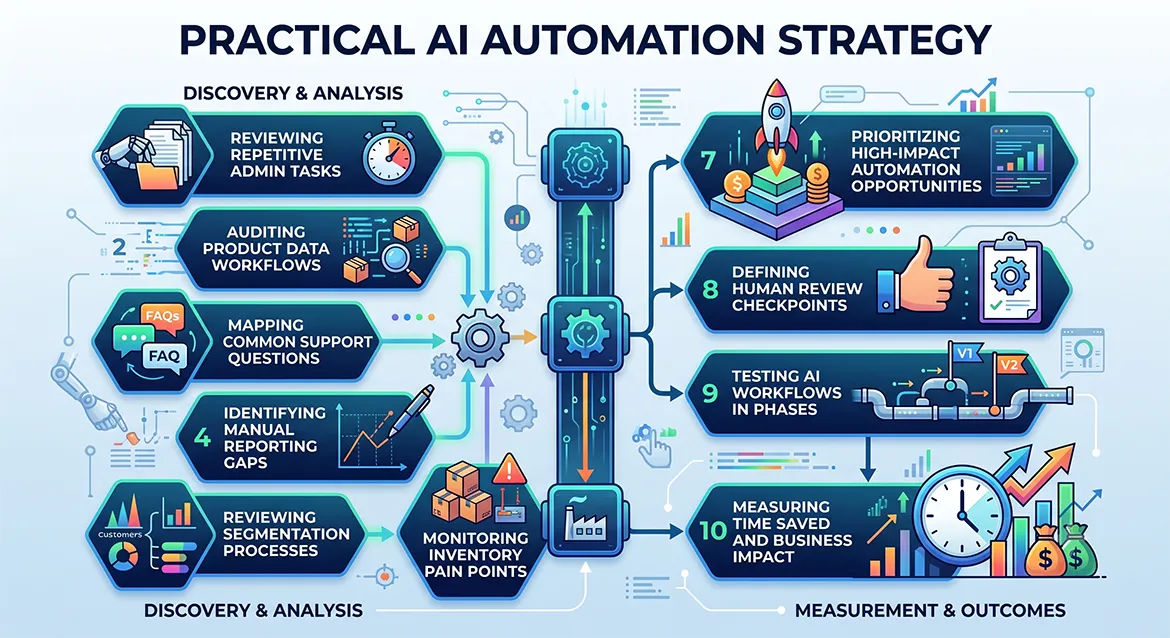
AI should not be added only because it is available.
It should be applied where it helps teams reduce friction, improve accuracy, and support growth.
From Manual Workflows to Smarter Commerce
Manual workflows can quietly limit eCommerce growth.
They slow down teams, create operational gaps, delay decisions, and make scaling harder than it needs to be.
AI helps by turning repetitive work into smarter workflows. It can support product data cleanup, customer support, campaign segmentation, reporting, inventory alerts, merchandising, and operations.
The result is not just faster work.
It is a more efficient commerce operation that gives teams more time to focus on strategy, customers, and growth.
Improve eCommerce Efficiency With Smarter Automation
If manual workflows are slowing your team down, identify where AI can create the biggest operational lift.
Improve product data, support, reporting, inventory monitoring, and campaign efficiency with smarter automation.