

Customization Decisions Shape Future Scalability
In the world of digital commerce, growth often comes with a hidden cost customization debt.
What starts as a quick fix to meet a business need for custom checkout logic, tailored integrations, and unique frontend experiences can gradually evolve into a fragile system that becomes harder to maintain, upgrade, and scale. Many Adobe Commerce (Magento) merchants don’t realize this until it’s too late when a routine upgrade turns into a multi-month rebuild, or performance begins to decline under the weight of accumulated custom code.
Building a scalable Adobe Commerce store isn’t about avoiding customization altogether. It’s about making strategic decisions that balance flexibility, performance, and long-term growth.
What Is Customization Debt and Why It Matters
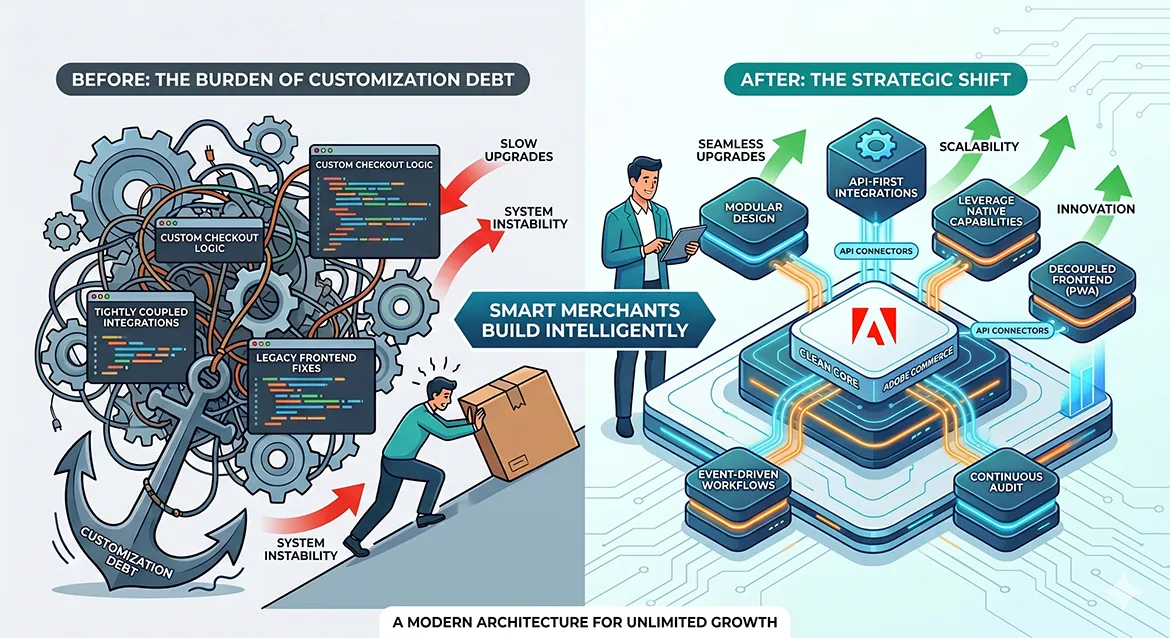
Customization debt is similar to technical debt, but with a more specific impact on commerce platforms. It refers to the long-term complexity and risk introduced by deep, tightly coupled customizations especially those embedded directly into core platform logic.
Over time, this leads to:
- Slower upgrade cycles and higher maintenance costs
- Increased risk of bugs and system instability
- Reduced agility when launching new features or campaigns
- Performance bottlenecks that impact user experience and conversions
We’ve worked with merchants managing millions of SKUs and high-traffic environments where even minor changes required extensive regression testing simply because the system had become too tightly customized.
The result? Innovation slows down. Growth becomes reactive instead of proactive.
The Shift: From Customization to Strategy
Modern Adobe Commerce success isn’t defined by how much you customize it’s defined by how intelligently you design your architecture.
Smart merchants are moving away from “customize everything” and toward a more strategic model:
- Build only what creates competitive advantage
- Leverage native platform capabilities wherever possible
- Decouple systems to reduce dependency and risk
- Design for scalability from day one not as an afterthought
This shift is what separates brands that continuously evolve from those that get stuck maintaining legacy systems.
12 Key Strategies to Avoid Customization Debt
Modern approaches like Adobe Commerce extensibility build on these principles by enabling flexible, out-of-process customizations allowing merchants to innovate without increasing platform risk.
| Strategy | What Smart Merchants Do | Business Impact |
|---|---|---|
| Modular Architecture Design | Build features as independent modules instead of large, tightly coupled customizations | Faster development cycles, easier maintenance, lower upgrade risk |
| Keep Core Platform Clean | Avoid modifying Magento core; extend using APIs, plugins, and services | Seamless upgrades and long-term platform stability |
| Adopt Integration-First Approach | Connect ERP, CRM, and marketing tools via APIs instead of embedding logic in Magento | Flexibility to scale and swap systems without disruption |
| Limit Over-Customization | Customize only where it creates real business differentiation | Reduced technical debt and lower long-term costs |
| Leverage Native Capabilities | Use Adobe Commerce’s built-in features before building custom solutions | Faster time-to-market and reduced complexity |
| Decouple Frontend & Backend | Separate frontend experiences (e.g., PWA/Hyvä) from backend logic | Improved performance, UX flexibility, and scalability |
| Implement Event-Driven Workflows | Use asynchronous processing for inventory, orders, and integrations | Better performance under load and real-time data handling |
| Optimize Catalog & Indexing Strategy | Reduce unnecessary indexing, optimize batch processing, and control reindex triggers | Faster site performance and efficient handling of large catalogs |
| Standardize Development Practices | Follow coding standards, version control, and deployment protocols | Fewer bugs, consistent releases, and easier collaboration |
| Plan for Upgrade Compatibility | Evaluate every customization against future upgrade impact | Avoid costly rebuilds and ensure platform longevity |
| Automate Monitoring & Alerts | Implement proactive alerts for failures, sync issues, and performance drops | Faster issue resolution and reduced operational risk |
| Continuously Audit & Refactor | Regularly review and optimize existing customizations and integrations | Keeps the platform lean, scalable, and future-ready |
The Role of Experience: Why Strategy Matters More Than Ever
At Rave Digital, as an Adobe Technology & Solution Partner, we’ve seen firsthand how different architectural decisions play out over time.
We’ve helped merchants:
- Stabilize platforms impacted by heavy customization
- Transition from reactive fixes to scalable systems
- Build architectures that support millions of products and real-time operations
- Deliver SEO-safe migrations without disrupting growth
The common thread across successful transformations isn’t just better technology, it’s better decision-making early in the process.
Scalable Commerce Requires Continuous Optimization
Creating a future-ready Adobe Commerce store isn’t a one-time project. It’s an ongoing strategy that evolves with your business.
It requires:
- Regular evaluation of your architecture
- Continuous optimization of integrations and workflows
- Alignment between business goals and technical execution
And most importantly, it requires a shift in mindset from short-term customization to long-term scalability and flexibility.
Build for What Comes Next
Customization isn’t the problem unstructured, tightly coupled customization is.
The most successful Adobe Commerce merchants aren’t the ones who customize the most; they’re the ones who build intelligently, scale efficiently, and adapt quickly. They make deliberate architectural decisions that support growth instead of limiting it.
By focusing on modular design, a clean core platform, and strategic integrations, you can create a commerce ecosystem that not only meets today’s business needs but is also prepared for future expansion, innovation, and evolving customer expectations.
If you’re evaluating how to future-proof your Adobe Commerce store or reduce customization debt, it may be time to rethink your approach not just in terms of tools, but in terms of long-term strategy and scalability.
Ready to Future-Proof Your Adobe Commerce Store?
Connect with our Adobe certified experts to assess your current architecture and identify opportunities to reduce customization debt, improve performance, and scale with confidence.